


Food manufacturing
Prove your people can do the job, not just that they did the training
Xapify is a food manufacturing skills matrix that verifies competency on the line, where the work happens, and keeps a timestamped record for every worker, task, and site. When the auditor asks, you run a report instead of opening a binder.





The sign-off sheet is in a binder. The binder is at another site.
Most food plants verify competency the way they always have. A supervisor watches someone run the slicer, signs a sheet, and the sheet goes in a folder. Then someone updates the skills matrix on the shared drive. Eventually.
It holds together until it doesn’t. A new starter is on the line before anyone has signed them off. A refresher lapses and nobody notices. Each site keeps records a little differently, so nobody can see across the business. And when the auditor asks for evidence that the person on the metal detector check is competent, someone loses an afternoon to filing cabinets.
With the turnover most lines carry, competency is never finished. The records have to keep up with the people. It’s the same problem in every high-consequence industry, from food plants to hospital wards.
How Xapify works on a food site
1
Set requirements once, by job role
Decide what each role needs to be verified on. A sanitation operator, a boning room operator, and a line leader each get the right competencies automatically, based on their role, site, and business unit. When someone changes role or moves site, their requirements follow them.
Requirements can differ by business unit and site, so a bakery and a meat plant in the same group can verify different things and still report in one place.
If you use Workday, Oracle, or SAP SuccessFactors, Xapify syncs people, roles, and locations from it, so nobody sets up new starters by hand.
2
Verify at the line
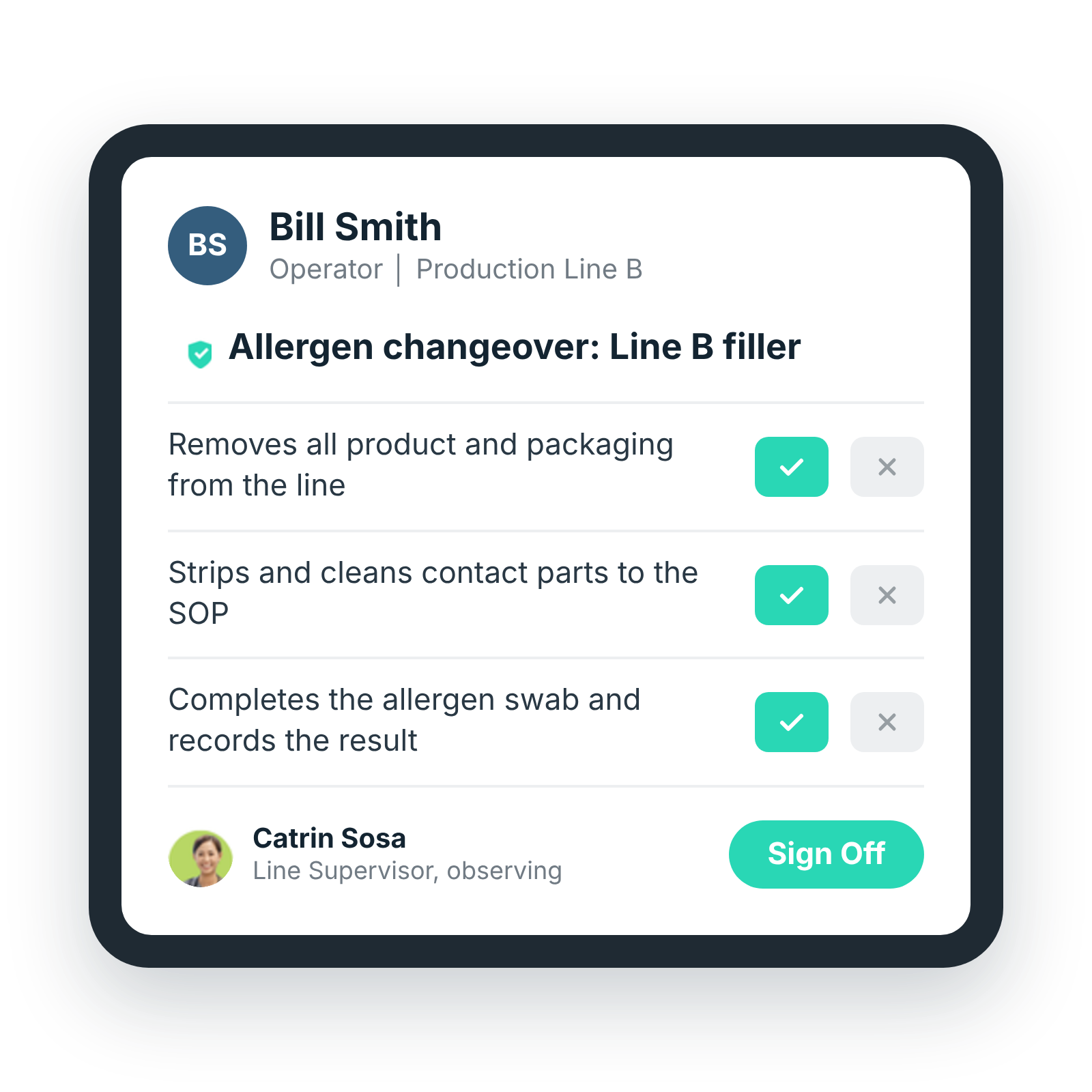
A supervisor watches an operator do an allergen changeover and signs it off on a tablet, at the line, while it's fresh. Not from memory at the end of the shift. Sign-off works on a phone, tablet, or desktop, wherever the work is.
You decide who's allowed to sign off each competency. A team leader might verify knife skills, while only your food safety lead can sign off a critical control point check. Every record shows who verified it.
3
Match the method to the task
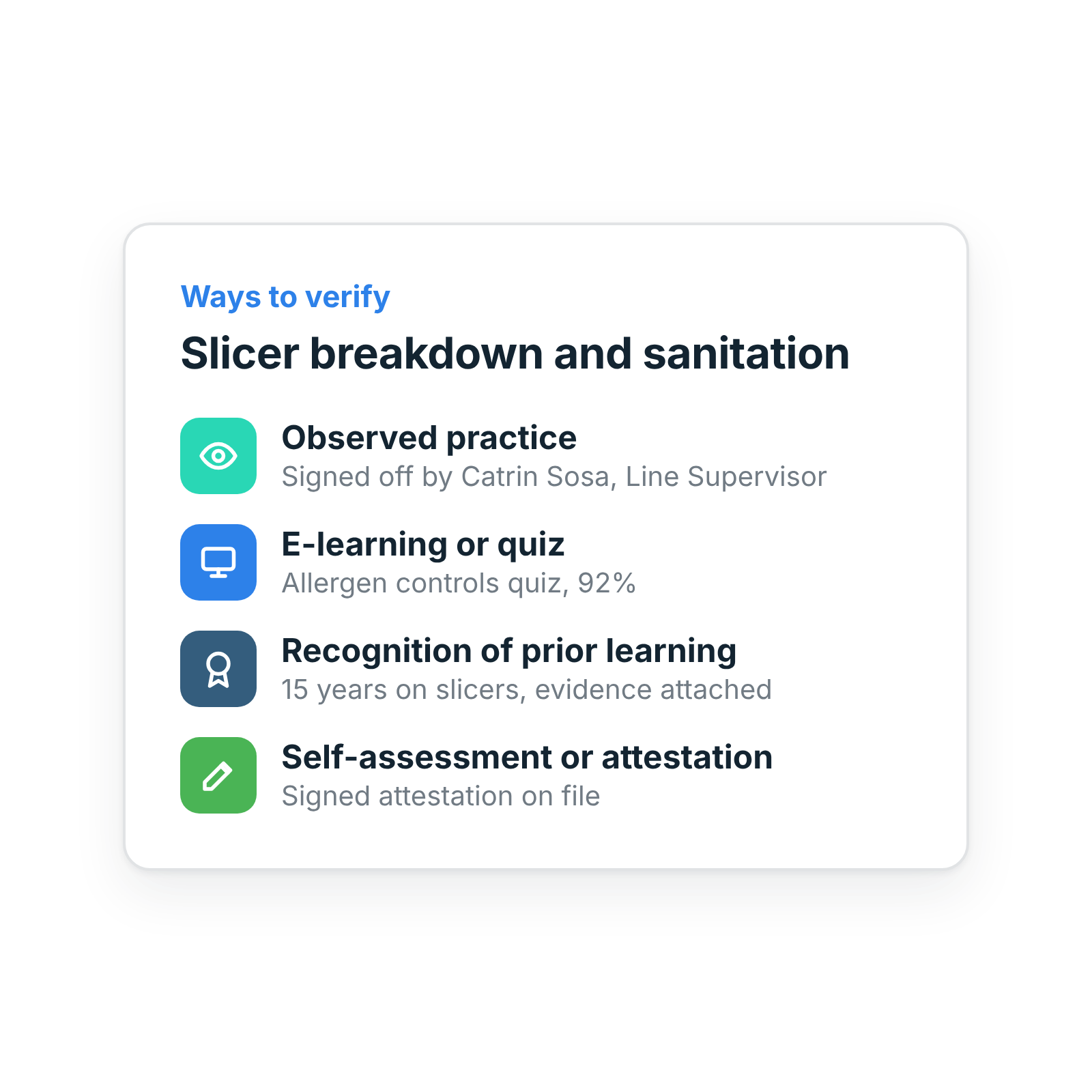
Not every competency needs the same kind of proof. Each one can be verified by:
- observed practice, with an assessor's sign-off
- an e-learning module or quiz
- recognition of prior learning
- self-assessment or a signed attestation
Watch someone break down and sanitize a slicer. Quiz them on allergen controls. Recognize the 15 years an experienced operator brings, and keep the record that shows why. If e-learning doesn't suit someone, say because English is their second language, verify them by observation instead.

4
See it across every site
Reporting is live, by team, site, or the whole organization. You can see who isn't signed off on the metal detector check at your second plant before audit week, not during it.
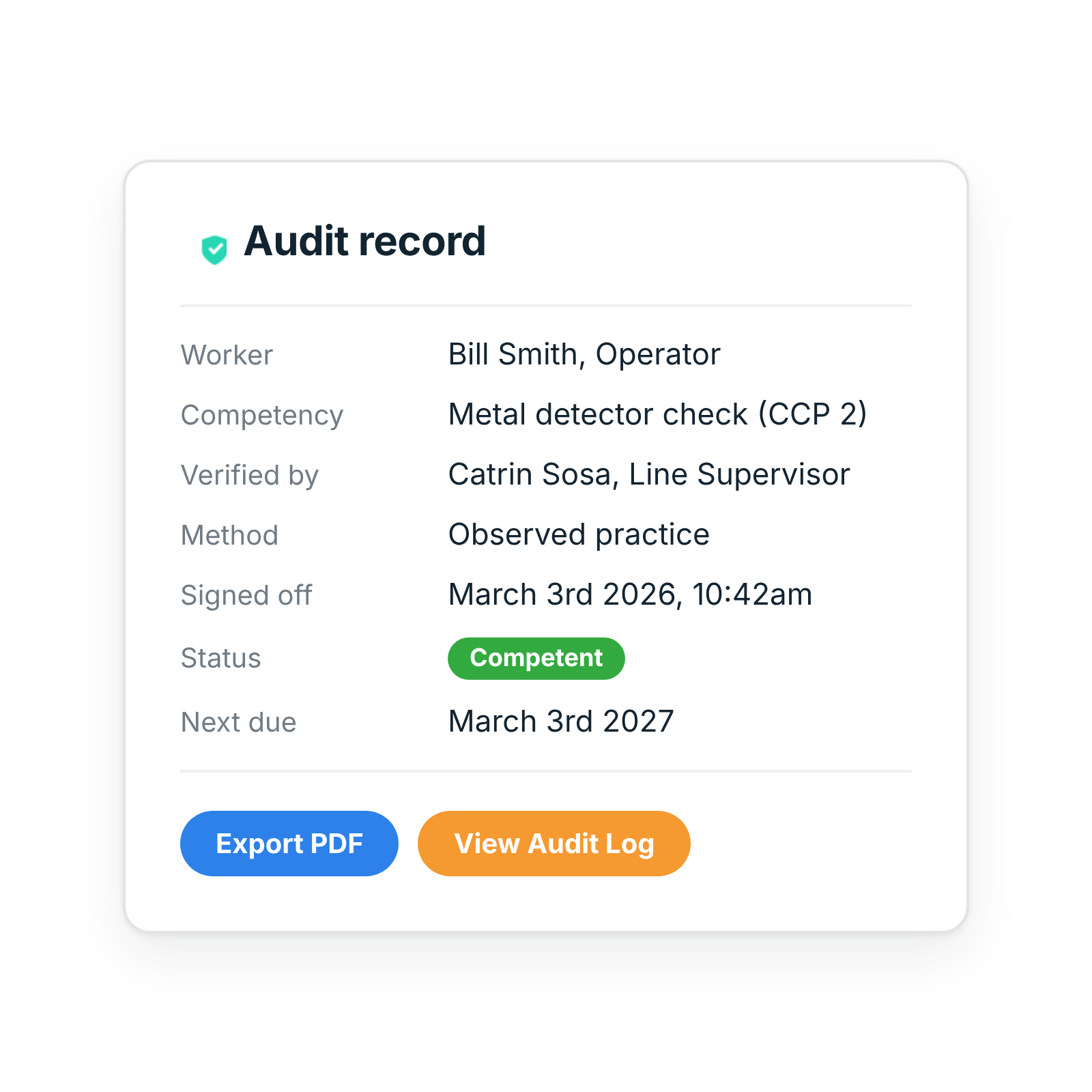
Every record is timestamped and exportable: who was verified, on what, by whom, how, and when. Pull it by worker, team, or site, and give the auditor what they asked for.
Xapify also tracks when each competency is due for re-verification, so refreshers don't quietly lapse.
You decide who's allowed to sign off each competency. A team leader might verify knife skills, while only your food safety lead can sign off a critical control point check. Every record shows who verified it.
From bakery lines to boning rooms
You build the competencies your sites need. Here's the kind of work you can verify:
Hygiene, gowning, and high-care zone entry
Allergen changeover and cleaning verification
Critical control point monitoring, like metal detection and cook temperatures
Knife skills and boning room safety
Running slicers, mixers, bandsaws, ovens, and packaging lines
Sanitation and chemical handling
Forklift and pallet jack operation
Threat and vulnerability assessment for your food defense and food fraud team
Built for the audit you actually face
Your sites might be certified to BRCGS, Safe Quality Food (SQF), FSSC 22000, or IFS. Either way, the auditor wants more than a training log. They want documented evidence that the people doing critical work are competent to do it, and they want to trace it.
Xapify doesn't write your food safety plan, and it won't sit the audit for you. It keeps the evidence that your people can do what the plan says they do.
Working to BRCGS? Start with our BRCGS competency gap checklist.
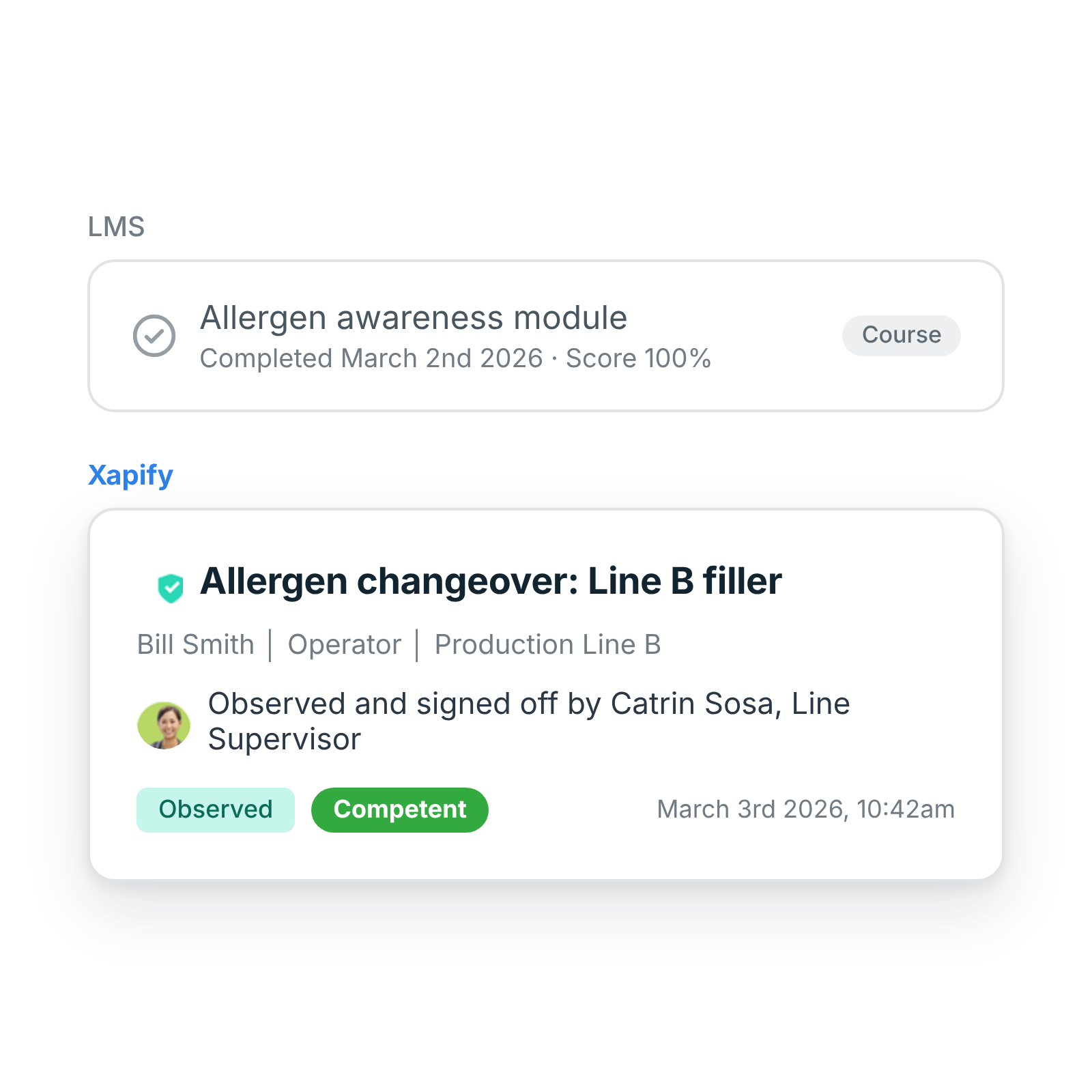
Your LMS records the course. Xapify records the competence.
A learning management system (LMS) can tell you someone finished the allergen module. It can't tell you they ran a changeover correctly on Tuesday with a supervisor watching. Your auditor wants to see both, and only one of them lives in your LMS.
Xapify sits alongside your LMS and HR system. It doesn't replace them. Courses stay where they are. Xapify adds the part those systems were never built for: verified, signed-off competence on each task, tied to each person's role.
HR platforms have skills modules too. They're built for office jobs, where nobody has to watch you run a pasteurizer before you're allowed near one.
Every record is timestamped and exportable: who was verified, on what, by whom, how, and when. Pull it by worker, team, or site, and give the auditor what they asked for.
Who uses it
Quality and food safety managers
One view of who's verified, who isn't, and who's due, across every site. Audit prep stops being a project.
Operations and site leaders
See who's signed off to run which line when you plan the shift, not after something goes wrong.
Training and HR leads
Set requirements by role once. New starters get the right competencies from the day they're added.
Supervisors and line leaders
Sign someone off on a phone or tablet, then get back to the line.
How DON got 2,500 skills into one system
DON makes smallgoods in Castlemaine, Victoria, and is part of George Weston Foods. Before Xapify, the same skill data could be recorded up to three different ways by different administrators. Audits were harder than they needed to be, and working out who was missing what took far too long.
Pay at DON is linked to qualifications, so a late record meant a late pay increase. DON also set up a buddy and assessor system, so qualified employees could verify their peers. It runs Xapify under its own name, donLearn.
hours of data entry every three months
less waiting for pay increases tied to skill verification
Find out how Xapify’s Skills Matrix can help your organization
Book a 30-minute demo to see how we help operations teams save time, close training gaps, and reduce compliance risk.