

Nurse competency validation
Prove competence in practice, not attendance at the skills fair
Xapify is nurse competency validation software that verifies competence where care happens, on the unit and by role, and keeps a timestamped record of who was verified, on what, by whom, and how. When the surveyor asks, you run a report instead of chasing checklists.




A completed checklist tells you something happened. It doesn't tell you a nurse is ready.
Most hospitals still prove competency the way they always have. An annual skills fair, a pile of paper checklists, a module ticked off in the LMS. It shows a nurse turned up. It doesn't show what they'll do at 3 a.m. when a patient's condition changes and nothing goes to plan.
What matters is readiness. Competency means showing you can do the job safely in your actual role, not proving you sat through a session or passed a test.
The old way costs more than it looks. When every unit or hospital keeps its own checklists, educators rebuild the same competencies over and over, and preceptors spend their time on paperwork instead of coaching. It's the same problem in every high-consequence industry, from hospital wards to food plants.
How competency validation works in Xapify
Step 1
Define competency your way, by role and unit
There's no single definition of nurse competency. It changes by hospital, specialty and unit, and it should. In Xapify you build the competencies your organization needs and attach them to job roles, units, departments, or the whole hospital. A med-surg RN, an ICU RN and a charge nurse each get the right requirements automatically, and when someone transfers, their requirements follow them.
Keep each unit's list short and meaningful. A handful of competencies you verify properly beats a long list nobody has time to check.
If you use Workday, Oracle, or SAP SuccessFactors, Xapify syncs people, roles, and locations from it, so nobody sets up new hires by hand.
Step 2
Verify performance on the unit
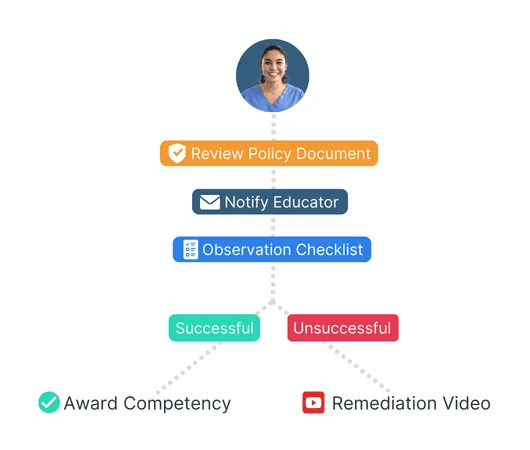
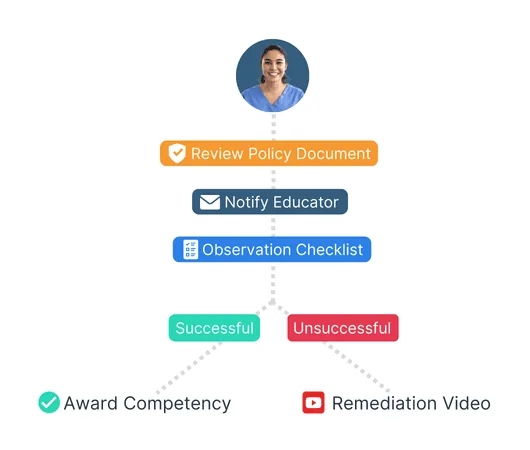
A preceptor or educator watches a nurse perform a skill during patient care and signs it off on a phone or tablet while it's fresh. Not from memory at the end of the shift, and not only at a skills station once a year.
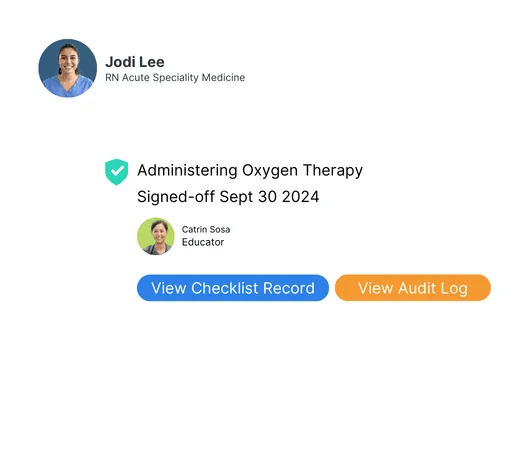
You decide who's allowed to sign off each competency. A preceptor might verify routine skills, while only a qualified educator signs off the high-risk ones. Every record shows who verified it.
Nurses can also request a sign-off from a qualified educator, supervisor, or peer, so evidence gets collected as the work happens.
Step 3
Make clinical judgment visible
Judgment and critical thinking are the hardest things to prove. A quiz won't show them. Watching a nurse work through a real or simulated situation, and hearing their reasoning, gets much closer.
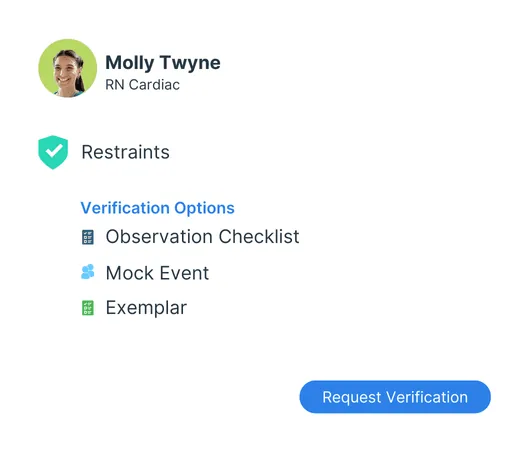
Not every competency needs the same kind of proof. Each one can be verified by:
- observed practice, with an assessor's sign-off
- an e-learning module or quiz
- recognition of prior learning
- self-assessment or a signed attestation
Recognize the 15 years an experienced nurse brings to a new unit, and keep the record that shows why. If e-learning doesn't suit someone, verify them by observation instead.
Step 4
Share the ownership, see it in one place
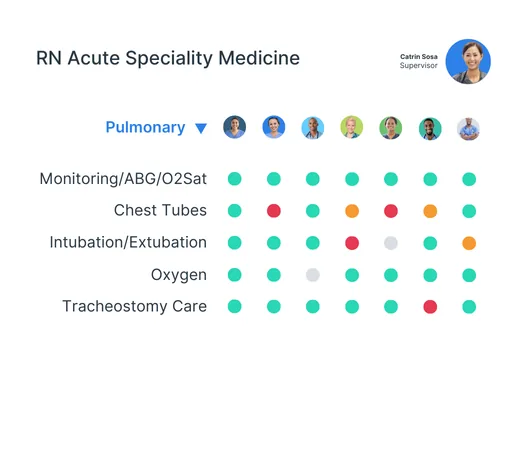
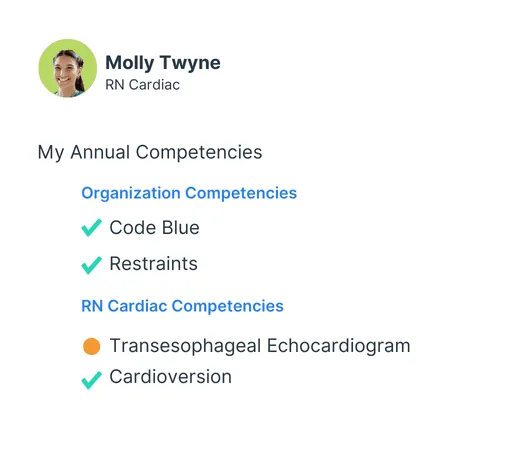
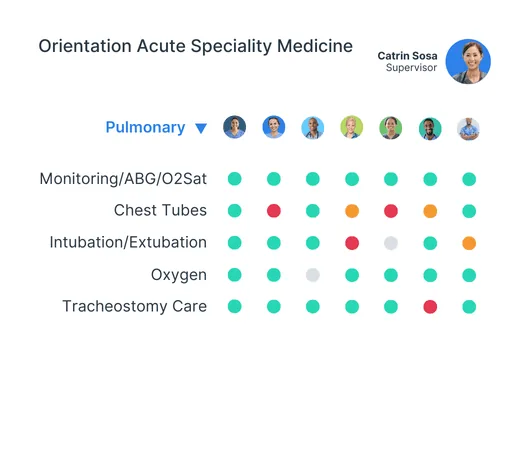
Competency works best as a shared job. Nurses keep their own competencies current, professional development sets the structure, and unit leaders gather the evidence. Xapify gives each of them their own view: nurses see what's due, educators see who needs verifying, and managers see readiness across the unit.
Reporting is live, by unit, department, or the whole organization. Xapify tracks when each competency is due for re-verification and sends reminders, so annual requirements don't quietly lapse.
From orientation to annual validation
You build the competencies your units need. Here's the kind of work you can verify, whether it's nursing orientation or annual competencies:
Medication administration, including high-alert medications
Central line care and dressing changes
Blood product administration
Recognizing deterioration and calling a rapid response
Infusion pumps and other medical devices
Point-of-care testing
Restraint use and patient safety checks
Low-volume, high-risk skills that need a regular refresher
Competency is a staffing question, not just a compliance one
When competency lives in binders and spreadsheets, preceptors spend their time on paperwork and educators rebuild the same checklist for every unit. Managers can't easily see who's ready for which assignment.
Put it in one system, by role, and that time goes back into coaching. Managers can see who's verified for which unit before they build the roster, and orientation can move at the pace of the nurse instead of the paperwork.
That's why more nursing leaders now treat competency as part of recruitment, retention and staffing, not a box to tick once a year.
Built for the survey you actually face
Whether it's a Joint Commission survey or a state inspection, surveyors want more than a training log. They want evidence that the nurse at the bedside is competent for the role they're in, and they want to trace it.
Xapify doesn't write your competency program, and it won't sit the survey for you. It keeps the evidence that your nurses can do what your policies say they do: who was verified, on what, by whom, how, and when. Pull it by nurse, unit, or hospital and hand over what was asked for.
Your LMS records the module. Xapify records the competence.
A learning management system (LMS) can tell you a nurse finished the blood transfusion module. It can't tell you they checked and hung a unit correctly on Tuesday with a preceptor watching. Surveyors want to see both, and only one of them lives in your LMS.
Xapify sits alongside your LMS and HR system. It doesn't replace them. Courses stay where they are, and Xapify adds the part those systems were never built for: verified, signed-off competence on each skill, tied to each nurse's role.
Training is how a nurse gets there. Verification is how you know they arrived.
Who uses it
Nurse educators and professional development
Set requirements by role once, then spend your time coaching instead of chasing signatures.
Unit managers
See who's verified for what on your unit before you build the roster.
Nursing leaders
One view of readiness across every unit and hospital, ready for survey day.
Nurses and preceptors
See what's due, ask for a sign-off, and verify a colleague on a phone or tablet.
How Nebraska Medicine took mock codes off paper
Nebraska Medicine partnered with Xapify to digitize several clinical and non-clinical skill programs, starting with mock code blues. A mock code tests readiness under pressure, which is exactly what a checklist can't show.
See how Xapify helps hospitals prove readiness
Book a 30-minute demo. Send us one of your own competency checklists first, and we'll build it into Xapify so you can see your own process working.