
For clinical educators
Nursing competency checklists
Outlines of common nursing competency checklists, grouped by area, plus what every checklist needs before anyone signs it off. Use them to check your own list for gaps.
These are outlines, not clinical guidance. Your hospital's policies and procedures decide what each checklist says.
The library
What each checklist usually covers. The detail comes from your own policy.
Vascular access and infusions
Usually high on the list for orientation and annual review.
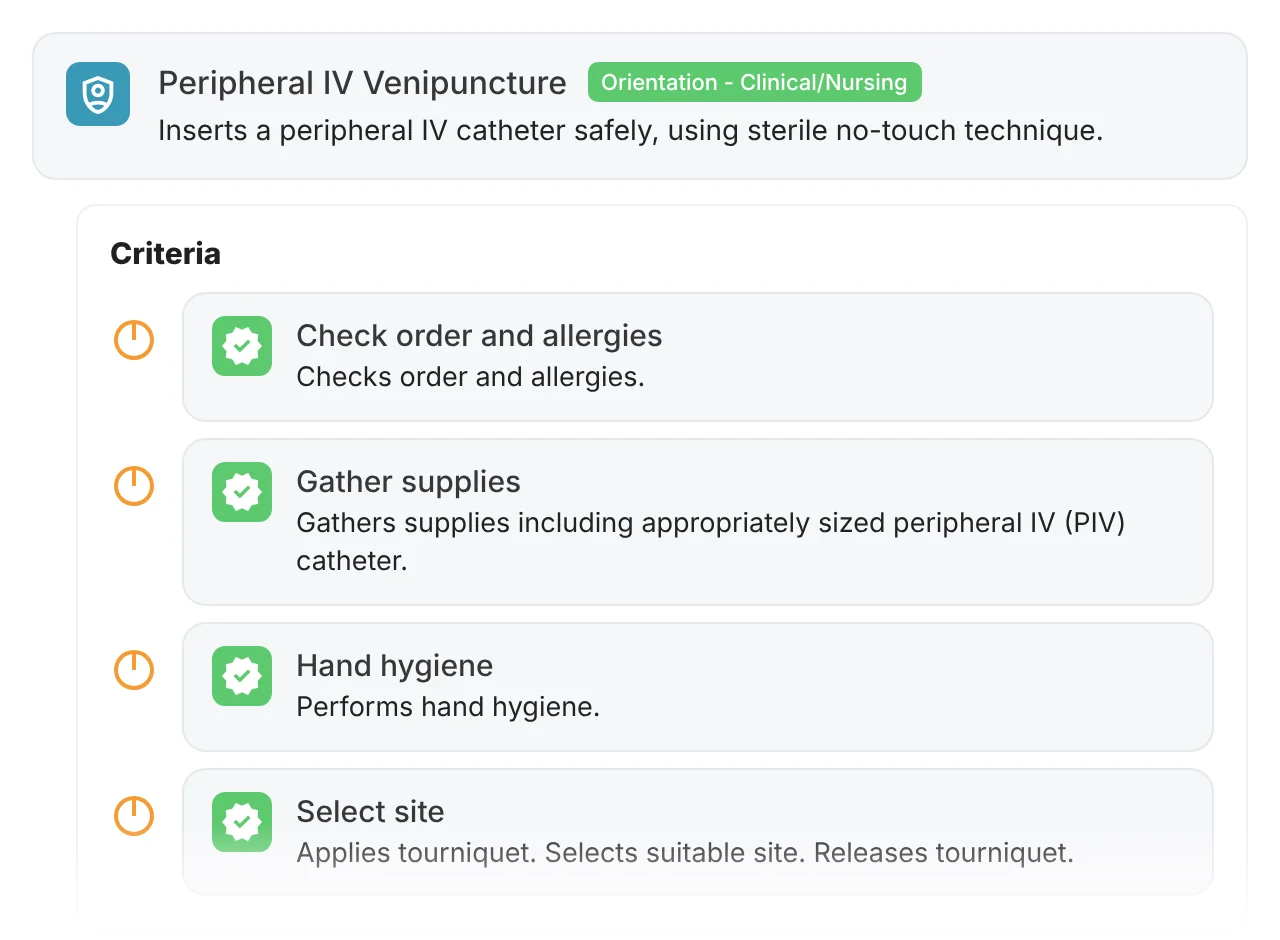
- Peripheral IV insertion
- Preparing the patient and equipment, choosing a site, aseptic insertion, securing and dressing the line, and documenting it.
- Infusion pump programming
- Setting up the hospital's pump, using the drug library, responding to alarms, and independent double checks where policy calls for them.
- Central line care
- Dressing and cap changes, accessing the line with aseptic technique, assessing the site, and knowing which complications to escalate.
- Blood transfusion
- Identifying the patient at the bedside, checking the product against the order, monitoring during the transfusion, and what to do if a reaction is suspected.
Medication safety
The checks that sit around every dose.
- Medication administration
- Checking the order, the patient and the medication, barcode scanning, and documenting what was given.
- High-alert medications
- Which medicines your hospital treats as high alert, when an independent double check is needed, and the extra monitoring involved.
- Patient-controlled analgesia
- Setting up and programming the pump, teaching the patient, and monitoring sedation and breathing.
- Blood glucose and insulin
- Point-of-care testing with the hospital's meter, giving insulin, and recognising and treating low blood glucose under your protocol.
Assessment and monitoring
Often assessed by observation on the unit rather than in a skills lab.
- Head-to-toe assessment
- A structured physical assessment, what to document, and when a change needs escalating.
- Cardiac monitoring
- Applying leads, setting alarms, recognising the rhythms your unit expects staff to know, and who to tell.
- Falls risk and prevention
- Using the hospital's falls risk tool and putting the right precautions in place for each patient.
- Skin assessment and pressure injury prevention
- Using the risk assessment tool, repositioning, support surfaces, and documenting skin condition.
- Pain assessment
- Choosing the right pain scale for the patient, reassessing after treatment, and documenting both.
Emergencies and escalation
Skills people hope not to need often, which is why they get checked.
- Rapid response and code blue
- Recognising deterioration, calling for help, roles in the room, and finding things on the crash cart.
- Crash cart and defibrillator checks
- The routine checks, what's in the cart, and how defibrillator testing is done and recorded.
- Sepsis screening
- Using the hospital's screening tool and following its escalation process.
- Restraints
- Alternatives to try first, applying restraints under policy, and the monitoring and documentation they need.
Infection prevention
Short checklists, checked often.
- Hand hygiene
- The moments for hand hygiene, technique, and when soap and water is needed instead of hand rub.
- PPE and isolation precautions
- Choosing PPE for each type of precaution, putting it on and taking it off in the right order, and signage.
- Urinary catheter insertion and care
- Aseptic insertion, ongoing care, and reviewing whether the catheter is still needed.
- Wound care
- Assessing the wound, aseptic dressing technique, and documenting progress.
Equipment and safe handling
Where checklists usually multiply: one per device or system.
- Safe patient handling
- Using lifts, slide sheets and other equipment, and knowing when to get more help.
- Tracheostomy care and suctioning
- Routine trach care, suctioning technique, and the emergency equipment kept at the bedside.
- Enteral feeding
- Confirming tube position under your policy before use, running the feeding pump, and flushing.
- Blood gases
- Drawing and handling arterial samples and running them at the bedside, often shared with respiratory therapy.
- Medical devices
- Each device a nurse uses needs its own sign-off, often with training from the manufacturer as well as your own.
Most units add their own on top: arterial lines and vasoactive infusions in critical care, fetal monitoring in maternity, triage in the emergency department, and age-specific checklists on children's units.
What every competency checklist needs
Whatever the skill, a checklist is only as good as the record it leaves behind.
A clear name and scope
What the competency covers, and what it doesn't.
Who it applies to
The roles and units that need it, so new starters get it automatically.
The critical steps
What the assessor has to see. Not every step of the procedure: that's what the policy is for.
How it is verified
Observed on the unit, return demonstration, simulation, a quiz, or a mix.
Who can sign it off
Preceptors, educators or other assessors your hospital has approved for that skill.
Dates, signatures and a due date
When it was signed off, by whom, and when it needs verifying again.
Orientation, annual competencies and new equipment
The same checklist turns up at different times. New nurses work through a set during orientation, usually with a preceptor signing them off on the unit. Experienced staff re-verify a smaller set each year as annual competencies, often chosen for risk or recent incidents. And when a new pump or monitor arrives, everyone who'll use it needs signing off before the old one goes.
Looking for a skills checklist for a travel assignment?
Those are self-assessments: you rate your own experience with each skill, and your staffing agency supplies the form. A competency checklist is the other half: someone qualified watches you do the skill and signs it off.
Off the clipboard
Paper checklists have a habit of ending up in lockers, staffroom drawers and the back seats of cars, usually the week before a survey.
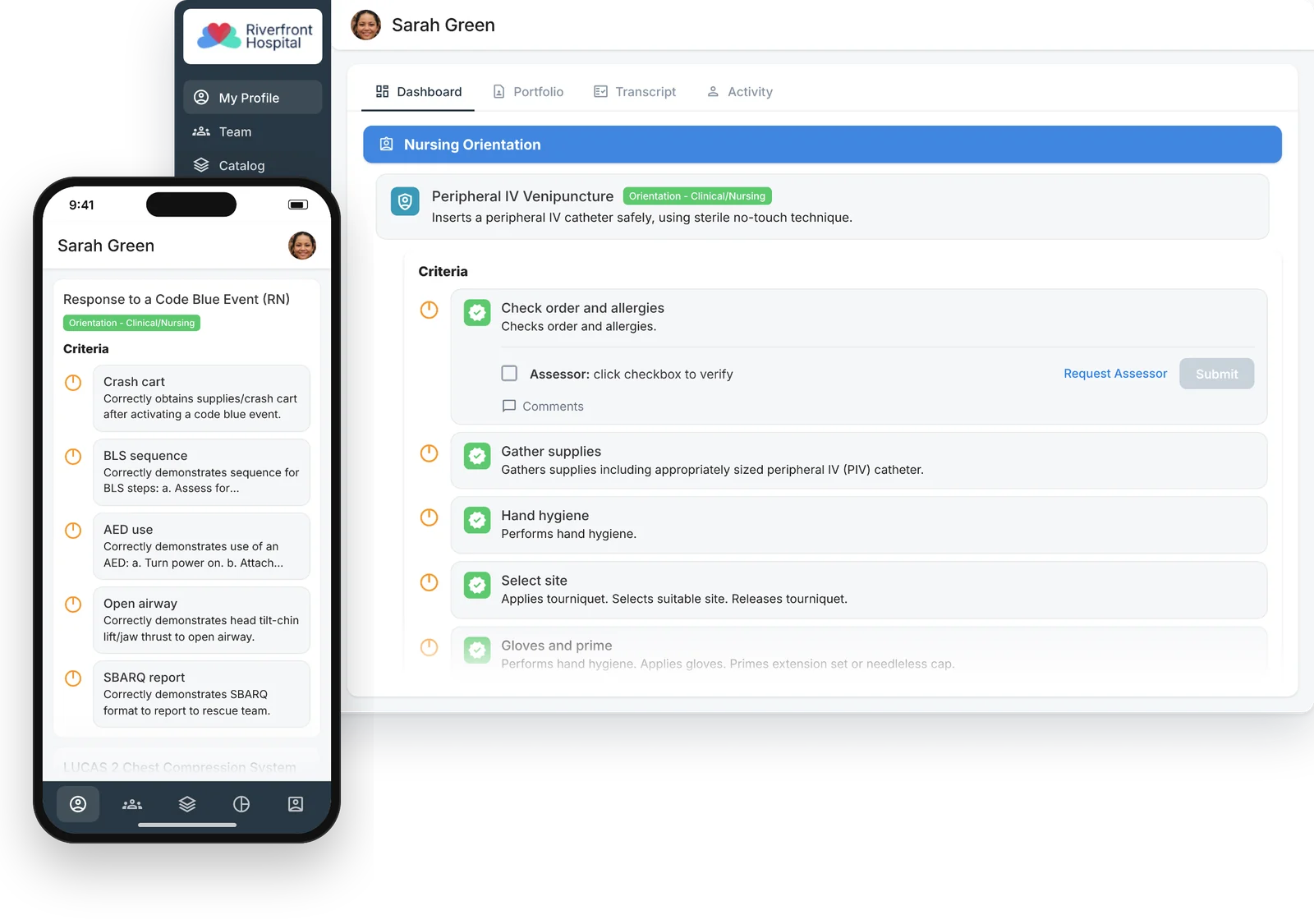
In Xapify each checklist is assigned by job role and unit, signed off on a phone or tablet at the bedside by an approved assessor, and timestamped. Educators see who is done, who is waiting to be observed and who is overdue, without chasing paper.
- Build your own checklists, or send them to us and we'll build them
- Restrict sign-off to qualified assessors
- Flags what's due before it lapses
Orientation packet health check
Still running orientation from a binder?
Send us one blank packet. We'll show you what's in it and how it looks in Xapify.
Questions educators ask
What is a nursing competency checklist?
A list of the critical steps of a nursing skill that an assessor watches for, with space to sign off when the nurse has shown they can do it. Hospitals use them in orientation, for annual competencies and when practice or equipment changes.
What's the difference between a skills checklist and a competency checklist?
A skills checklist is usually a self-assessment: a nurse rates their own experience, often for a staffing agency before a travel assignment. A competency checklist is signed off by someone else who has watched the nurse do the skill.
How often do nurses complete competency checklists?
Most hospitals verify core skills during orientation and then on a cycle their own policy sets, often yearly, plus whenever practice, policy or equipment changes.
Who can sign off a nursing competency checklist?
Whoever your hospital approves as an assessor for that skill: usually preceptors, educators, charge nurses or trained super-users. In Xapify you can restrict each sign-off to qualified assessors.
Can I download these checklists?
They're outlines, not forms, because every checklist has to match your own policies, equipment and scope of practice. Send us one of yours and we'll build it in Xapify for your demo.
Send us one of your checklists
We'll build it in Xapify, so your demo shows your own skills, not ours.
Book a demo