
The most underrated AI dataset in your hospital
 11 November 2026 · Nick Stephenson
This week someone emailed to ask what Xapify’s clinician records, training logs and audit reports would be worth to an AI lab. Their rough maths put it somewhere between a lot of money and quite a lot of money.
The short answer is that it doesn’t matter, because they’re not ours to sell. That data belongs to the hospitals and the people in it. We look after it for them, and that’s the end of that conversation.
But the email got me thinking. Someone out there has worked out that this kind of data is valuable. I think they’re right, just not in the way they think.
Most workforce data proves attendance
Ask most hospitals what they know about their workforce and you’ll get two things: HR records and LMS completions.
HR tells you someone’s job title, unit and start date. The LMS tells you they finished the infusion pump module on 3 March, probably at 2am, possibly with the sound off.
Neither tells you whether that nurse can safely set up the pump. That’s the gap, and it’s the one that matters when something goes wrong.
Competency data proves capability
When an assessor watches a nurse perform a skill and signs it off against a standard, you get something rare. It’s verified evidence that a specific person did a specific thing, safely, on a specific date.
It’s tied to a job role. It has an assessor’s name on it. It expires when it should and gets renewed when it’s due.
That’s the closest thing a hospital has to ground truth about who can do what.
It’s also exactly what AI needs to be useful, because AI is only as good as what you feed it. Feed it completions and it’ll confidently tell you everyone’s fine.
What AI can actually do with it
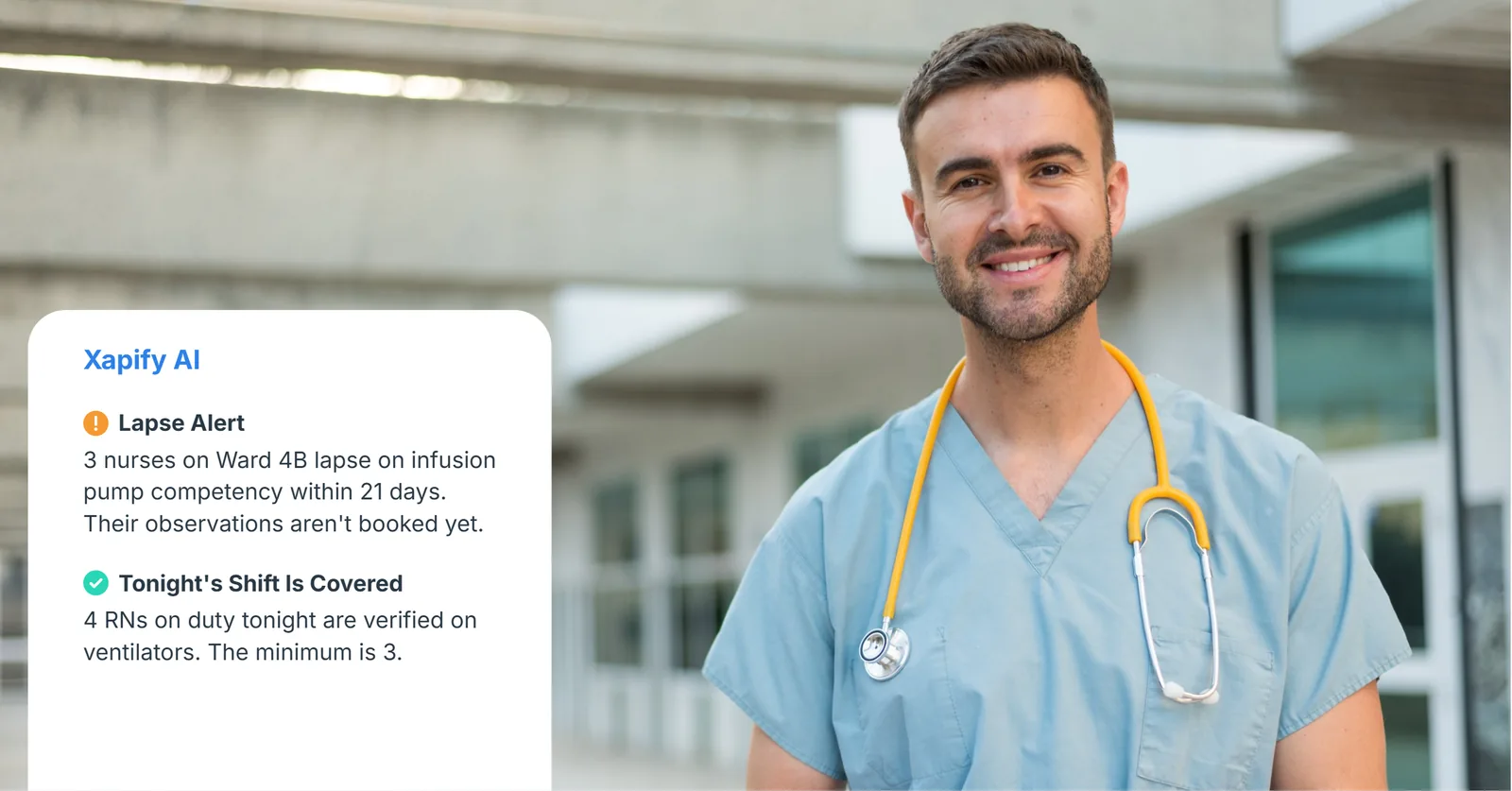
- See lapses coming. Not “who’s overdue”, but “which unit loses its last nurse signed off on the new ventilator in three weeks”. That’s a problem you’d rather hear about now than at 2am.
- Answer the staffing question properly. Rosters count heads. The real question is whether tonight’s shift has enough people competent in what tonight’s patients need, and good competency data can answer it before the shift starts.
- Find where people get stuck. Time to competency for new grads, the skills that take three attempts, the assessors who sign off a lot faster than everyone else. Patterns nobody can spot across thousands of records show up quickly.
- Build competencies faster. Give AI a policy or a device manual and it can draft the competency, the checklist and the assessment questions in minutes. An educator still reviews it and owns it, but they start from a draft instead of a blank page.
Benchmarks are where boards start listening
One hospital’s data tells you about one hospital. Pool it carefully, de-identified and only with each customer’s agreement, and you get benchmarks.
How long do your new grads take to reach competency compared with similar hospitals? Are your lapse rates normal for a system your size? Which units are carrying the most risk?
Boards don’t read competency matrices, but they understand benchmarks. That’s how workforce capability stops being an education department report and becomes a board conversation about risk.
What AI shouldn’t do with it
It shouldn’t replace the assessor. Signing off a skill is a professional judgement made by someone who watched it happen. AI can draft, predict and flag, but a person still signs.
And the data shouldn’t be sold. Competency records describe real people and their work. The value is in using them to keep patients and staff safer, not in feeding them to someone else’s model.
Where to start
If you lead nursing or clinical education, ask one question of every system you use: does this record prove someone completed something, or that they can do it?
If the answer is mostly “completed”, that’s your starting point. Capture competence as evidence that’s observed, signed and dated, not as paperwork. The AI value follows the evidence, not the other way round.